


Table of Contents
- Interior Projects in Dubai: The Gap Between the Dream and the Reality
- 7 Reasons Interior Projects in Dubai Fail After Sign-Off
- Are You Making These Renovation Mistakes?
- How to Protect Interior Projects in Dubai From Approval to Handover
- How to Choose a Fit-Out Company That Delivers What You Approved
- Why Turnkey Fit-Out Reduces the Risk on Interior Projects in Dubai
- Final Thoughts on Why Interior Projects in Dubai Go Wrong After Approval
- FAQs
Many interior projects in Dubai start the same way. You know the feeling of looking at the 3D drawings of your new place, and they look incredible. The textures match, the lighting is warm, and the design team confidently tells you, “Yes, no problem, we can build this exact look.” You sign the approval sheet feeling excited. Then the site work starts.
Suddenly, the marble slabs look duller than the samples. The custom door frames show up looking completely different, and the site team tells you that they had to interpret your drawings because the factory couldn’t build the original plan. By the time you finally get the keys, your home looks somewhat similar to the pictures, but it’s not what you agreed to.
If this has happened to you, you’re probably wondering: why do interior projects in Dubai always go wrong after approval? It’s enough to make you think that every renovation in the city is bound to disappoint you.
As a content writer, I spent time reading reports and articles on this topic, and I found the physical execution gap to be one of the most common interior renovation mistakes in Dubai. It is behind many of the failures that happen after a design is approved. Other delays start before work even begins, during the fit-out approval process.
When choosing a fit-out company in Dubai, understanding these pitfalls matters. Let’s look at exactly why interior projects in Dubai always go wrong after approval and how you can safeguard your home.
Interior Projects in Dubai: The Gap Between the Dream and the Reality
Many homeowners imagine that once they approve a design, they can sit back, relax and wait for the interior design project to finish. In reality, they have only just crossed the starting line. This sudden drop in quality is known in the industry as the fit out execution vs design concept gap.
Designs look like pictures of a perfect room when you approve a design presentation. But construction takes place in the real world and around concrete, wiring, ducts and tools. The design team who created your vision may often leave as soon as you approve the renderings, looking to find their next client and sidelining your project to another, separate site team.
Unless the site team has a particular supervisor monitoring each measurement to ensure it matches the approved plans, the little adjustments start to occur. For the busy worker, the change to the drawing seems unimportant. But when twenty minor adjustments happen, suddenly what’s being installed looks nothing like your great rendering.
Construction research backs this up. During my research on this topic, I reviewed a study led by construction researcher Professor Peter Love at Curtin University.
Based on 19,605 rework events across 346 construction projects, it found that rework cut the contractor’s mean yearly profit by 28%, and that just 0.45% of the rework events caused 34% of the total rework costs. The owner always ends up footing the bill when no one closes the gap between the drawings and the actual site work.
On the first day, ask your designer: “Are you going to go there every single week to oversee progress against your drawings, or is someone else going to be doing this?” Include the response in your contract.
7 Reasons Interior Projects in Dubai Fail After Sign-Off
To protect your property, you need to understand where it’s vulnerable. If you want to know exactly why interior contractors fail after design sign off, look at the reality of the construction floor.
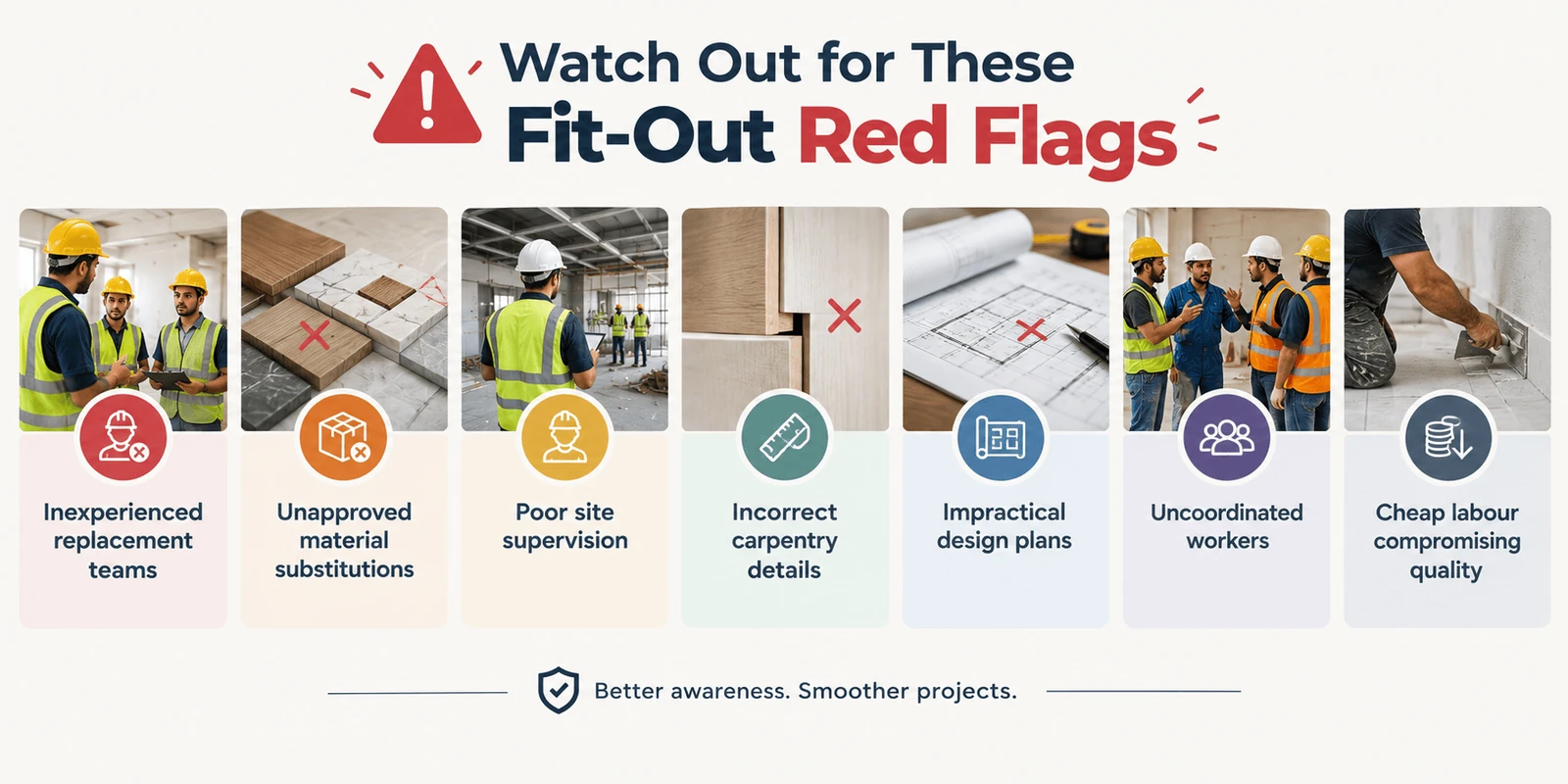
The A Team Disappears After Signing
When a company pitches for your business, they bring their sharpest project leaders and best presentation boards. They go all out, but once you hand over that first cheque, the deal is sealed. Some crews go all in to secure the contract, then hand the work over to less skilled and less costly workers once the project is in progress.
The Work Gets Passed to Subcontractors
You thought you hired a team of fitters, but in many cases you didn’t. After winning the project, many companies pass the work down the line to different workers. The worker installing your tile never even saw your approved drawings.
Approved Materials Get Swapped
This is one of the most common complaints among Dubai owners. You approved a specific European tile, a textured wall fabric or a solid oak door profile. Weeks later, you see something that looks familiar but arrives in generic boxes.
Instead of telling you about shipping delays, your contractor quietly replaces your tile with a cheaper, locally sourced alternative. According to RICS research on regional disputes, changes in project scope and late or incomplete design information are the most consistent top causes of distress on capital projects in the Middle East. A quiet material swap is exactly that kind of scope change.
Nobody Checks the Shop Drawings
An owner on Reddit said he spent hours choosing the exact trim and opening angles for bespoke wooden doors. When delivery day arrived, the carpentry shop had simply built what they always build for standard projects. Why did that happen? Because the on-site project manager never checked the factory shop tickets against the approved interior drawings.
The doors were installed incorrectly, rejected by the owner and had to be ripped out. When site managers do not hold a tape measure against the drawings, mistakes get installed right into your walls. Industry dispute data from HKA shows that contract administration was behind 20.5% of construction disputes in the Middle East, compared with 15.4% in the rest of the world.
The Design Cannot Actually Be Built
Some visual concepts look stunning on a computer screen, but they cannot actually be built in a real Dubai apartment. A concept designer might draw a flush, continuous ceiling without checking where the main air conditioning fan coil unit or access hatch must go.
When the build team opens the ceiling and spots the duct-work, they realise the rendering is impossible to build. Instead of calling an urgent design review, they make an ad-hoc box on site. The clean look disappears overnight because the designer never checked the physical building conditions.
No One Leads the Site
There is a saying: too many cooks and no head chef spoil the dish. On a disorganised site, you may have a plumber, a painter and an electrician all working on the same job at once, with no one leading. Because they work independently, no one feels responsible for the end result, and mistakes slip through.
The Quote Was Too Cheap to Be Real
If a contractor gave you an impossibly cheap quote to win the job, they can’t actually take that financial hit. They will try to protect their margin by using quality materials at the front entrance and cheaper labour and materials in the bedrooms.
Knowing why interior contractors fail after design sign off helps you protect yourself. Always ask your contractor to show you their trade license and a list of their permanent, in-house employees versus third-party subcontractors. Make sure your agreement states that your dedicated site supervisor is present on your site every day, rather than splitting their time across five different villas.
Are You Making These Renovation Mistakes?
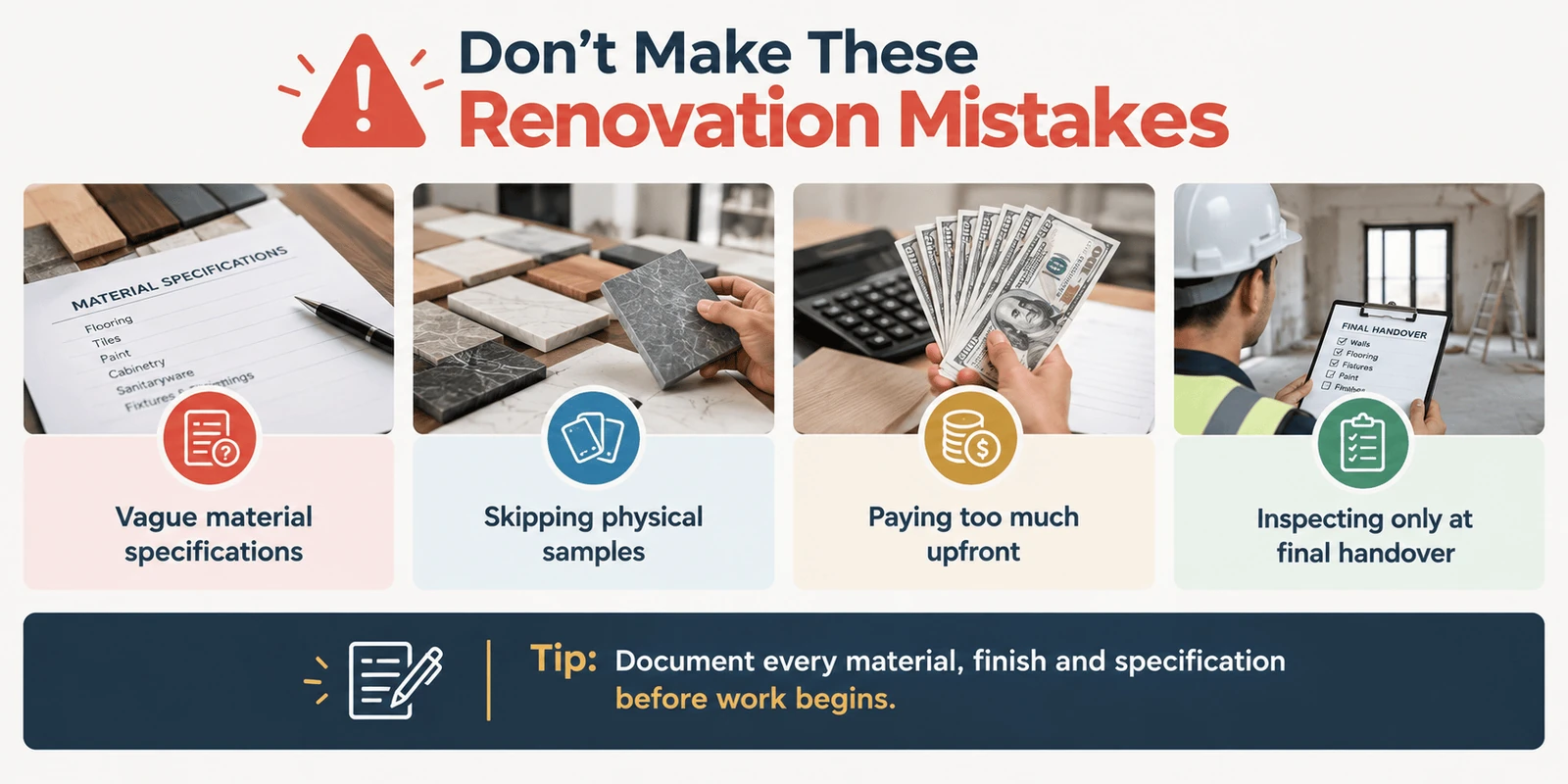
When you look at why do interior projects in Dubai always go wrong after approval, it isn’t only contractors who make errors. While researching, I found that common interior renovation mistakes in Dubai sometimes start on the owner’s side, with simple errors made before work even begins:
- Agreeing to vague specifications: Writing “top-quality Spanish tiles” in a proposal instead of setting out the brand name, model code, size, finish and grout colour.
- Ignoring physical mock-ups: Scrolling through paint colours on your phone instead of testing sample pots on your own walls in daylight.
- Paying too much in advance: Paying 50% or 60% of the project value before workers set foot on site.
- Inspecting only at handover: Making your first proper visit at handover, when the plumbing and electrical work is already sealed behind the walls.
Under Dubai Law No. 6 of 2019, developers must repair defective installations such as electrical, mechanical and plumbing systems for one year from handover. That rule covers the developer of a new unit, so for renovation work your protection comes from your contract.
If you rely on a verbal promise from a site foreman instead of a formal, photographed fit-out snagging checklist in Dubai, you lose your leverage when those fixes never happen.
What to do next: To avoid common interior renovation mistakes in Dubai, create a detailed material schedule spreadsheet before demolition begins. List every paint code, tile brand, sanitary ware model and door finish, and attach it to your final contract.
How to Protect Interior Projects in Dubai From Approval to Handover
You don’t have to be an expert builder to make sure your house is protected; you just need some common sense and a good, solid contract. If you are researching how to avoid interior fit out delays in Dubai, start with these five simple ideas to keep your home project on course:
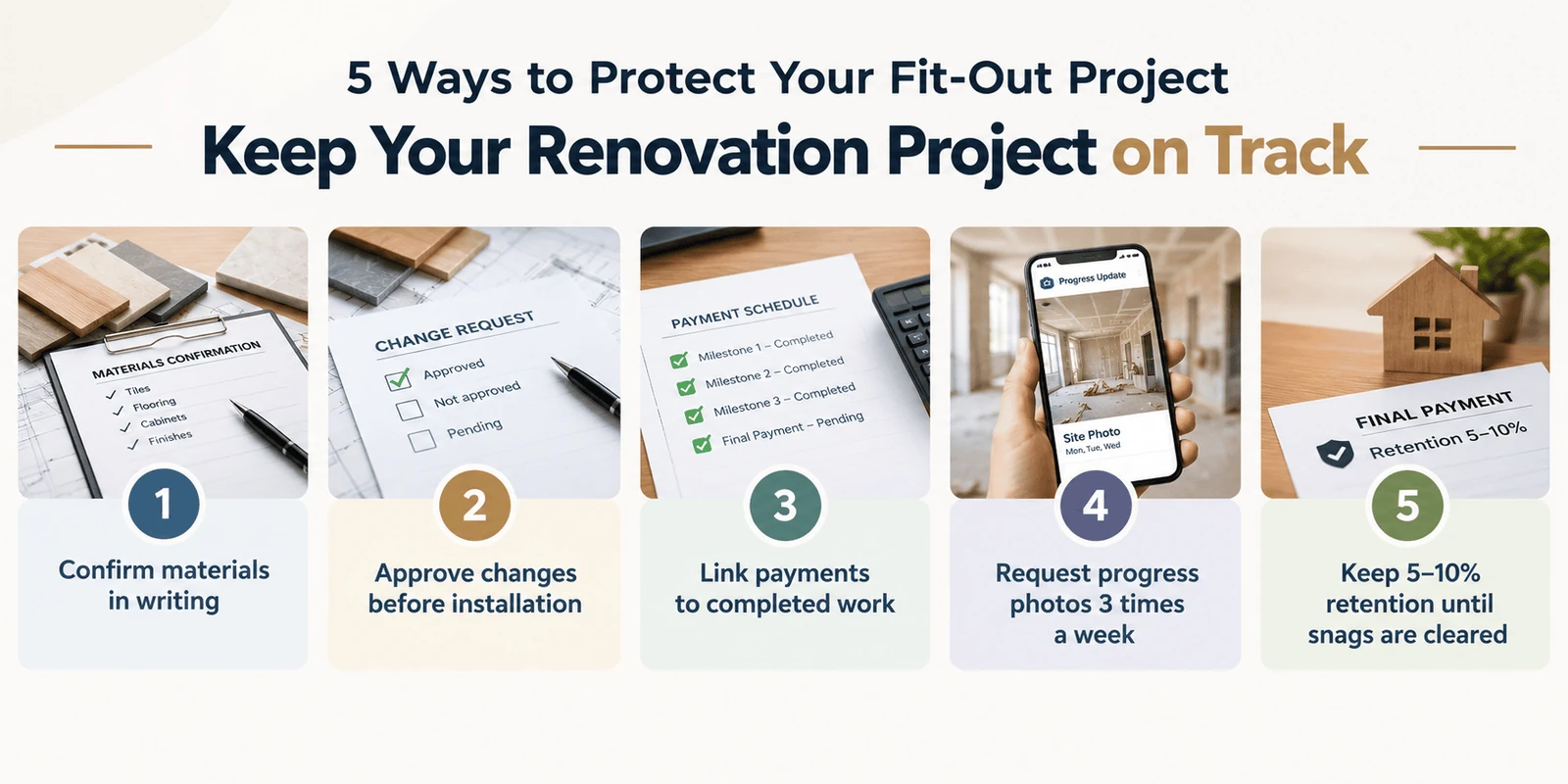
- Lock materials in writing: Never rely on verbal promises. Attach physical samples or signed spec sheets directly to your contract, and state that the contractor must use those exact items.
- Add a no substitution clause: Include a simple sentence in your contract: no material, finish or layout detail may be substituted without the client’s prior written approval, and any unapproved substitution must be removed and replaced at the contractor’s sole expense. This stops site teams from quietly using alternative items.
- Pay by stage, not by date: Pay only when a specific, measurable stage is completed and approved, for example one payment after tiling and another after the joinery is in.
- Ask for progress photos: Ask your project manager for time-stamped photos and videos three times a week.
- Hold back a retention: Keep a 5% to 10% retention payment for thirty days after completion, and release it only once your snag list is fully cleared.
How to Choose a Fit-Out Company That Delivers What You Approved
The most important decision you’ll make is which fit-out company you select. If you are researching how to choose a fit-out company in Dubai, avoid picking one just because of its nice-looking 3D images.
- Visit an active site: Look at the floor protection and the cleanliness of a project they are building now, not just their showroom.
- Meet the site manager: Meet the person who will actually manage the job site, not the salesperson.
- Ask about in-house trades: The top fit-out companies in Dubai use a core group of in-house electricians, painters and carpenters.
- Call previous clients: Ask them one direct question: “Does the completed home match your approved 3D drawing?”
Why Turnkey Fit-Out Reduces the Risk on Interior Projects in Dubai
Another way to close the execution gap is a turnkey interior model in Dubai. Traditionally, you hire one company to design your home and a different contractor to build it. When problems come up, the contractor and the designer blame each other and pass the problem back to you, with fees.
For a successful interior fit-out in Dubai, a turnkey method keeps the whole project in one house. The draftsman, the detailers and the site manager all work for a single company. The designer talks to the site engineer before finishing the drawings, so every detail can actually be built. In that kind of team there is no scapegoat; one responsible team owns the project from start to finish.
If you want this level of dedicated service, working with the best fit-out company in Dubai gives you the oversight needed for a clean result.
What to do next: When comparing your initial quotes, ask each firm if their 3D concept designers also act as the technical site engineers. If you want to know how to avoid interior fit out delays in Dubai, this one question does a lot of the work. To remove conflicting points of contact, restrict your bids to companies that offer a single turnkey contract from concept to final handover.
Final Thoughts on Why Interior Projects in Dubai Go Wrong After Approval
To answer the central question: why do interior projects in Dubai always go wrong after approval?
Projects fail only when nobody takes full responsibility for site execution once the drawings are signed. When you lock your specifications in writing, tie payments directly to site progress, and hire a team that manages design and construction under one roof, you protect your budget. You can turn your approved design into the beautiful home you paid for.
Don’t let your dream home get lost in execution. Contact our fit-out team today to make sure your finished space matches your approved 3D design.
FAQs
Why do interior projects in Dubai always go wrong after approval?
This generally occurs when the design is given away to unmonitored site workers, resulting in the fit out execution vs design concept gap. Material exchanges are made without the knowledge of the client, or design notes are reduced to keep costs down.
Is a Contractor Allowed to Change Materials in Dubai?
No. Contractually, your contractor is obliged to provide everything that was in the scope of the signed contract (unless you’ve approved a change to this in writing).
How can I avoid delays on interior projects in Dubai?
Provide detailed technical specifications and drawings attached to your contract. Consider the number of site milestone inspections you will undertake and approve physical sample boards before work begins.
Should I hire a separate project manager for my renovation?
If you have a demanding job or travel often, an independent project manager can run site checks, confirm deliveries, and ensure the work matches your plans.
What needs to be incorporated into the fit-out contract in Dubai?
Full CAD drawings, precise quantities, milestone payments, a strict substitution clause, a daily liquidated damages clause and a retention of 5% to 10% until snagging is completed.